Digital marketing for small businesses means using your website, Google, social media and email to win customers online. For most UK small firms, start with a fast website, a complete Google Business Profile and enquiry tracking. Then add one channel at a time, and judge it on enquiries and sales, not likes.
This guide shows what to do first, which channels suit which businesses and what each one costs in 2026. It also covers UK rules on email, cookies, reviews and ad claims, plus a 90-day plan.
Why digital marketing matters for UK small businesses
The UK had 5.7 million private sector businesses at the start of 2025, according to government business population estimates. Small and medium-sized firms made up 99.85% of them. They provided 60% of private sector jobs and 51% of turnover.
The same figures show that 75% of UK businesses employ no one apart from the owners. So small business marketing in the UK has to fit around the day job.
Digital marketing for small businesses suits that reality. Many of the best tools are free or low cost. You can start small, measure results and grow what works.
Digital marketing for small businesses: start with the foundations
Every channel sends people to the same few places: your website, your Google listing and your phone. If those are weak, more traffic just means more lost enquiries. So build from the bottom up.
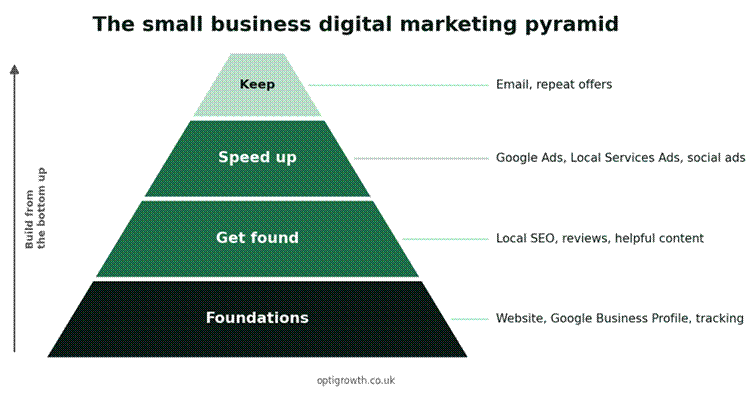
Figure 1: Build your digital marketing from the foundations up
1. A website that turns visits into enquiries
- Works well on phones, with a tap-to-call button near the top.
- Loads quickly, so visitors do not give up before it opens.
- Has one page per main service, saying what you do, where and for whom.
- Shows proof, such as reviews, photos of your work and any accreditations.
- Makes contact easy, with a short form, a phone number and opening hours.
- Includes a privacy notice, plus a cookie banner if you use non-essential cookies.
Our web design team builds small business sites around these points.
2. A complete Google Business Profile
A Google Business Profile is free, and it helps you appear on Google Search and Maps. You can reply to reviews, post updates and see the searches people use to find you.
Google says local ranking depends on relevance, distance and prominence. It also says there is no way to request or pay for a better local ranking. So complete every field, verify your business, add photos and reply to reviews.
3. Basic tracking
- Google Analytics 4 for website visits and enquiries.
- Google Search Console for the searches that show your site.
- Business Profile insights for calls, reviews and bookings.
- Call tracking if phone calls are your main source of work.
- A ‘How did you hear about us?’ question on forms and calls.
Our CRM and call tracking service connects these, so you can see which channel sent each customer.
Choosing the right online marketing for your small business
You do not need every channel. Pick one or two that match how your customers find businesses like yours. Add more once those work.
| Channel | Best for | How fast it works | How you pay |
| Google Business Profile | Any business with local customers | Builds steadily as you add detail and reviews | Free, plus your time |
| Local SEO and content | Services people search for on Google | Builds over months | Your time or an agency fee |
| Google Ads | Urgent or high-value searches | Ads can show as soon as they are approved | Per click, plus any fee |
| Local Services Ads | Eligible trades and some London services | Can start once set up and verified | Per lead |
| Facebook and Instagram ads | Visual products, local offers and events | Fast to launch | Per impression or click |
| Organic social media | Community, repeat custom and word of mouth | Slow to build | Your time |
| Email marketing | Repeat business from past customers | Fast to send | Low-cost software |
Which channels suit which small business?
| Business type | Start with | Add next |
| Trades and home services | Google Business Profile, Google Ads or Local Services Ads | Reviews, service pages and local SEO |
| Shops, cafes and salons | Google Business Profile and Instagram or Facebook | Email offers to past customers |
| Professional services | Service pages, local SEO and Google Business Profile | LinkedIn and helpful guides on your site |
| Online shops | Product pages, Google Ads and Meta ads | Email flows for repeat orders |
| B2B services | LinkedIn, service pages and SEO | Email nurture and case studies |
Not sure whether to start with paid or organic search? Our guide to Google Ads vs SEO for UK small businesses compares the two.
Local SEO: get found in your area
Local SEO helps you show up when people nearby search for what you do. For many small firms, it is the cheapest steady source of new customers.
- Complete your Google Business Profile, including categories, services, areas and opening hours.
- Use the same name, address and phone number on your website and every directory listing.
- Build a page for each main service, and for each town you serve if the work is genuinely there.
- Ask every happy customer for a review, and reply to every review, good or bad.
- Add real photos of your team, premises and finished work.
Never write, buy or swap fake reviews. The CMA’s fake reviews guidance covers fake reviews and undisclosed incentivised reviews under UK consumer law. Our local SEO checklist walks through every step.
Paid ads on a small business budget
Paid ads bring visitors quickly, but they stop when the budget stops. Start small, track every call and form, and only scale what brings customers.
Google Ads
Google Ads puts you in front of people already searching for your service. Focus on high-intent searches, such as ‘[service] near me’ or ‘[service] [town]’.
Add negative keywords to block job and DIY searches. Our Google Ads agency team manages small business accounts.
Local Services Ads for UK trades
Local Services Ads appear at the top of Google for certain service categories. In the UK, they cover trades such as electricians, plumbers, roofers, cleaners and heating engineers nationwide. Lawyers and estate agents can use them in Greater London only.
You pay only for leads related to your business and the services you offer. Businesses that pass Google’s checks can earn the Google Verified badge. See our Local Services Ads management page for set-up help.
Facebook and Instagram ads
Meta ads suit businesses with visual products, local offers or events. You can target by area and interests, and lead forms let people enquire without leaving the app. Our Meta ads agency runs lead campaigns for UK small businesses.
Social media and content marketing
Organic social media works best for building trust with people who already know you. Choose one or two platforms your customers use, post useful content regularly and reply to every message.
- Show your work: before-and-after photos, short videos and team stories.
- Answer common questions: prices, timings and what to expect.
- Share proof: reviews and results, with customer permission.
- Point to one next step: a call, a booking link or a contact form.
The CAP Code covers marketing on your own website and social accounts, so claims need evidence. Our social media marketing team can plan and run this for you.
Helpful pages on your own site matter too, such as cost guides and answers to common questions. They help with Google rankings and AI answers. Google says AI Overviews need no special optimisation beyond normal SEO best practice.
Email marketing for small businesses: the UK rules
Email is one of the cheapest ways to win repeat business from past customers. But UK law sets clear rules on who you can email or text.
The ICO’s guidance for small organisations says you need consent to email or text individual customers. The exception is when the soft opt-in applies. Sole traders and some partnerships count as individuals.
When the soft opt-in applies
- You collected the person’s details when they bought or asked about your products or services.
- You only market similar goods or services.
- You gave them a chance to opt out when you collected their details.
- You give them a clear, easy way to opt out in every message.
Emails to limited companies and limited liability partnerships do not need consent under PECR. You must still identify yourself and give a valid opt-out address.
The rules are enforced. In January 2026, the ICO announced fines totalling £225,000 against two firms for nuisance texts and emails. One had relied on invalid third-party data, so never buy email lists.
Our email marketing team builds compliant lists and campaigns.
UK rules every small business marketer should know
| Area | What it means for you | Where to check |
| Cookies | Non-essential cookies need consent, and no exception covers advertising cookies | ICO: What are the exceptions? |
| Email and texts | Consent for individuals unless the soft opt-in applies | ICO: Marketing and data protection in detail |
| Business emails | No consent needed for companies, but identify yourself and offer an opt-out | ICO: Business-to-business marketing |
| Reviews | No fake reviews or hidden incentives for reviews | CMA: Fake reviews (CMA208) |
| Ad claims | Claims on your site, social media and ads must be honest and provable | ASA: Scope of the CAP Code |
On cookies, the ICO describes a narrow exception for statistical purposes for aggregate analytics. It does not cover advertising, so ad and remarketing tags need consent.
How much does digital marketing cost for a UK small business?
ExpertSure’s UK pricing guide, updated in October 2026, uses agencies’ own published prices. Its monthly bands show what digital marketing for small businesses usually costs.
| Monthly budget | What it usually buys (ExpertSure) |
| Under £500 | One channel, done properly |
| £500 to £2,000 | A full retainer or two channels |
| £2,000 and above | Multi-channel and specialist work |
| Service | Published monthly price (ExpertSure, October 2026) |
| SEO | £185 to £1,967, with local packages at the bottom |
| PPC management | £145 to £1,200 at entry tier, plus ad spend |
| Organic social media | Usually quoted individually |
Ad spend is paid on top of any management fee. UK agencies usually quote excluding VAT, so expect 20% on top if they are VAT-registered. ExpertSure also found most agencies that publish terms roll monthly, with 30 or 31 days’ notice.
Do it yourself, hire a freelancer or use an agency?
| Option | Works best when | Watch out for |
| Do it yourself | Budget is tight and you have a few hours a week | Your time, and slow progress while you learn |
| Freelancer | You need one skill, such as Google Ads or web design | Cover for holidays and limited range |
| Small business marketing agency | You want several channels run as one plan | Make sure senior people do the work |
Before hiring, read our guide on how to choose a digital marketing agency, with 15 questions to ask.
How to measure your digital marketing
Followers and clicks are easy to count but do not pay the bills. Track the numbers that show whether marketing brings customers.
| Metric | What it tells you | Where to find it |
| Enquiries by channel | Which channels send calls and forms | GA4, call tracking and your enquiry log |
| Cost per enquiry | What each lead costs from paid channels | Ad platforms and your enquiry log |
| Enquiry to sale rate | Whether the leads are the right ones | Your CRM or a simple spreadsheet |
| Google Business Profile activity | Calls, bookings and the searches people used | Business Profile insights |
| Reviews | How many you get and what customers say | Google Business Profile |
| Revenue from marketing | Whether the spend pays back | Your sales records by source |
For a deeper look at tracking, read our guide to marketing attribution. The same principles apply to small firms.
A 90-day digital marketing plan for small businesses
Use this plan if you are starting from scratch or resetting. Spend a few hours a week, and review results at the end of each month.
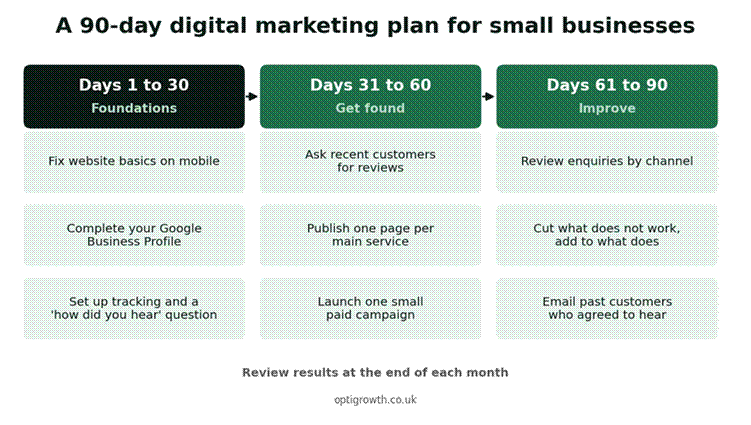
Figure 2: A simple 90-day plan
Days 1 to 30: foundations
- Check your website on a phone and fix contact buttons, speed and service pages.
- Complete and verify your Google Business Profile, with photos and services.
- Set up GA4, Search Console and a ‘How did you hear about us?’ question.
Days 31 to 60: get found
- Ask your last 20 happy customers for a Google review.
- Publish or improve one page for each main service.
- Launch one small paid campaign, such as Google Ads or Local Services Ads if eligible.
Days 61 to 90: improve and keep customers
- Review enquiries and cost per enquiry by channel.
- Cut what does not bring customers, and add budget to what does.
- Start a simple email to past customers who agreed to hear from you.
Case study: steady leads for a home services business
Prime HVAC Services is a residential and commercial heating and cooling company outside the UK. About 90% of its work came from referrals, and leads dropped sharply out of season. Over six months, we combined local SEO, Google Ads, Local Services Ads and a review process.
| Metric (six months) | Result |
| Qualified leads per month | 100+ |
| Cost per lead | Down 42%, to an average of $45 |
| Monthly website visitors | 4,200, up 320% |
The figures are in US dollars from outside the UK, so treat them as proof of the method. The same channels are open to UK trades, including Local Services Ads in eligible categories. See more results on our work page.
Common small business marketing mistakes
- Spending on ads before the website and Google Business Profile are ready.
- Trying every platform at once and doing none of them well.
- Judging success on likes and followers instead of enquiries.
- Buying email lists or emailing people without consent.
- Ignoring reviews, or replying to bad ones in anger.
- Not tracking calls, so phone leads go uncounted.
- Stopping too soon, before SEO and reviews have time to build.
FAQs: digital marketing for small businesses
What is digital marketing for small businesses?
Digital marketing for small businesses means using your website, Google listing, search, social media and email to win customers. For most UK small businesses, it starts with a mobile-friendly website, a complete Google listing and simple tracking. Then you add one or two channels that suit how your customers buy.
How much should a small business spend on digital marketing in the UK?
ExpertSure’s October 2026 guide shows under £500 a month usually covers one channel done properly. Between £500 and £2,000 buys a full retainer or two channels, with ad spend and VAT on top. Free tools such as Google Business Profile cost only your time.
What is the best digital marketing channel for a small business?
For most local businesses, the best first channel is a complete Google Business Profile. It is free and shows on Google Search and Maps. Trades may add Google Ads, while shops and cafes often do well on Instagram or Facebook.
Is Google Business Profile free?
Yes, Google says creating a Business Profile and listing your business on Google is free. It lets you appear on Search and Maps, reply to reviews and post updates. Google also says there is no way to pay for a better local ranking.
Can I send marketing emails to my customers in the UK?
Yes, if you have their consent or the soft opt-in applies. The soft opt-in covers past customers and enquirers, for similar offers, with an opt-out every time. Emails to limited companies do not need consent, but you must include an opt-out.
Should a small business start with social media or Google?
Start where your customers look for businesses like yours. If people search for your service when they need it, such as a plumber or accountant, start with Google. If they discover you by browsing, such as a cafe or gift shop, social media may come first.
Should I do digital marketing myself or hire an agency?
Doing it yourself works if your budget is tight and you have a few hours each week. A freelancer suits one skill, such as Google Ads. An agency suits several channels run as one plan, so check its proof and contract terms first.
Get a free marketing audit for your small business
OptiGrowth is a digital marketing agency based in Manchester, working with UK small businesses. We run SEO, Google Ads, Local Services Ads and social media as one plan built around enquiries.
Our free marketing audit includes a 30-minute strategy call and a 90-day growth roadmap, with no obligation. If you would rather talk first, contact our team directly.