Lead generation for software development companies means finding businesses that need software built and starting sales conversations with them. In 2026, the most reliable method combines Google Ads, SEO, LinkedIn outreach, email nurture and automation. Each channel feeds one tracked pipeline, so you stop depending on referrals.
This playbook shows the exact steps, the UK rules you must follow and what it costs. It also shares real results from our work with Innovent, a software development company.
What is lead generation for software development companies?
It is the work of attracting and qualifying businesses that may buy custom software or dedicated development teams. The aim is not more form fills, but more booked calls with decision-makers who fit your business.
Leads, qualified leads and sales opportunities
- Lead: a person or company that has shown interest, such as a download or a reply.
- Qualified lead: a lead that fits your ideal customer profile and has a need you can solve.
- Sales opportunity: a qualified lead that has agreed to a discovery call or asked for a proposal.
Agree these definitions with your sales team first. Without them, every channel report measures something different.
Why software development companies struggle to win consistent leads
Most software firms grow through referrals and repeat clients at first. That works well until referrals slow down, and then the pipeline swings between too much work and not enough.
Innovent, a software development and digital transformation company, faced this problem. It had limited inbound enquiries, an inconsistent pipeline and heavy dependence on referrals.
- Referral dependence: growth relies on word of mouth you cannot control.
- A crowded market: the ONS recorded 23,000 new information and communication businesses in the UK in 2024.
- Long sales cycles: custom software is a large purchase, often involving several decision-makers.
- Weak proof online: many websites list services but show few measurable results.
- No follow-up system: leads go cold when nobody nurtures them after first contact.
The software development lead generation playbook at a glance
These nine steps cover lead generation for software development companies from first research to a signed contract. They follow the order we use with software clients, and each step builds on the one before.
- Define your ideal customer profile and lead offer.
- Turn your website into a lead engine.
- Capture active demand with Google Ads.
- Build organic visibility in Google and AI search.
- Reach decision-makers with LinkedIn outreach.
- Add cold email and calls, within UK rules.
- Nurture every lead with email and fast follow-up.
- Use AI automation for research and admin.
- Measure pipeline, not clicks.
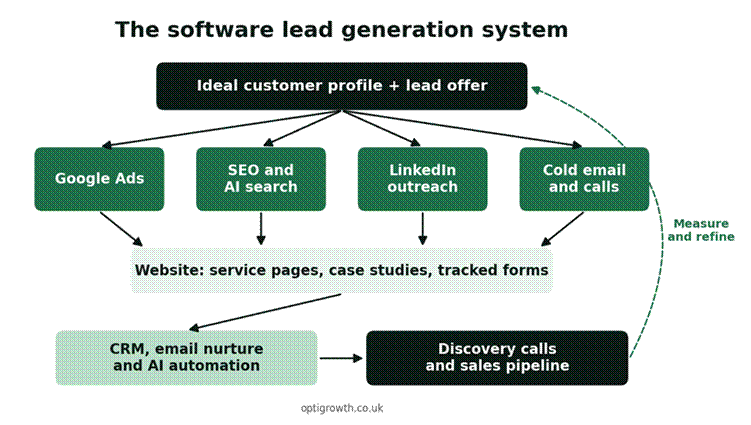
How the channels work together as one pipeline.
Step 1: Define your ideal customer profile (ICP) and lead offer
Your ideal customer profile describes the companies most likely to buy from you and stay. It shapes your keywords, ad targeting, outreach lists and case studies.
What to include in a software development ICP
| ICP field | What to decide | Options to consider |
| Company size | The staff and revenue range you serve best | Startups, scale-ups, mid-market or enterprise |
| Sector | Industries where you already have proof | For example fintech, healthcare, logistics or retail |
| Location | Markets you can sell into and support | UK only, UK and Europe, or wider |
| Buyer roles | Who signs off and who influences | CTO, founder, product manager, IT director |
| Trigger events | Signals that a project is likely | New funding, legacy systems, open developer roles |
| Lead offer | The first step you invite buyers to take | Discovery call, technical audit, scoping workshop |
Innovent’s outreach targeted CEOs, CTOs, founders, product managers and technology directors. Naming these roles early kept every message specific to the person reading it.
Buying signals worth tracking
- New funding: funded companies often need to build faster than their team allows.
- Developer hiring: repeated or long-open engineering roles can signal a capacity gap.
- Leadership changes: a new CTO or product lead often reviews existing suppliers.
- Legacy systems: outdated platforms create modernisation and migration projects.
- Company records: Companies House shows new directors, filings and incorporations.
If you sell a software product rather than development services, see how our SaaS marketing agency approaches acquisition.
Step 2: Turn your website into a lead engine
Every channel you run sends people to your website, so it has to build trust quickly. Otherwise you pay for traffic that leaves without enquiring.
- One page per core service: for example custom software, dedicated teams, AI development and modernisation.
- Case studies with numbers: show the problem, what you did and the measurable result.
- One clear call to action per page: usually a request to book a call.
- Short forms: ask only for what sales needs to qualify the lead.
- Fast, mobile-friendly pages: slow pages lose visitors before they read anything.
- Conversion tracking: record forms, calls and booked meetings as conversions.
Our conversion rate optimisation and web design work often starts here. Every other channel performs better once the website converts.
Step 3: Capture active demand with Google Ads
Google Ads reaches buyers at the moment they search for a supplier. It is the fastest route to qualified conversations, but only with tight targeting.
How to structure a software development Google Ads account
- Group campaigns by service. Innovent’s campaigns covered custom software, dedicated teams, AI development, digital transformation and enterprise software.
- Use exact and phrase match for commercial searches, such as people looking to hire a development partner.
- Add negative keywords early. For an enterprise software client, we excluded terms like free, job, course, pdf and definition.
- Match each ad group to a landing page, not your homepage.
- Track real conversions. Count qualified forms and booked calls, not page views.
- Review the search terms report weekly and move budget to what converts.
Google Ads results from the Innovent engagement
- 310+ qualified leads generated in six months.
- 5.8% average conversion rate from paid search traffic.
- 3.9x return on ad spend.
- 42% lower cost per lead than the starting baseline.
Add paid search and remarketing so visitors who did not convert see your proof again. For a second opinion on your account, speak to our Google Ads agency team.
Step 4: Build organic visibility in Google and AI search
SEO takes longer than ads, but it keeps producing leads without paying per click. It also affects whether AI tools, such as Google AI Overviews, find and cite your pages.
Pages that attract software buyers
- Service pages for each core offer, written around how buyers search.
- Industry pages for sectors where you have proof, such as fintech or healthcare.
- Case study pages that show measurable results.
- Cost and comparison guides, such as in-house development versus outsourcing.
- Technical guides that answer questions CTOs research before shortlisting suppliers.
How to get cited in AI Overviews and AI assistants
Google says there are no extra requirements to appear in AI Overviews or AI Mode (Google Search Central). The usual basics still apply: crawlable pages, internal links, good page experience and text-based content.
- Answer the main question in the first two or three sentences.
- Use clear headings, lists and tables that are easy to quote.
- Back claims with named sources and your own client numbers.
- Keep your company name, address and phone number consistent everywhere online.
SEO results from the Innovent engagement
- 128% growth in organic traffic.
- 45 keywords ranked on page one of Google.
- 18 high-intent keywords in the top three positions.
- 72% more inbound enquiries.
See how our SEO agency handles technical fixes, content and authority. If you are unsure which channel to start with, read Google Ads vs SEO for UK small businesses.
Step 5: Reach decision-makers with LinkedIn outreach
Many buyers are not searching yet when a project starts to take shape. LinkedIn lets you reach them by role, company size and sector.
A LinkedIn outreach process that books calls
- Update the sender’s profile first. Buyers check it before they accept a request.
- Build lists in Sales Navigator using your ICP filters and buying signals.
- Send a short connection request with a relevant reason to connect. Do not pitch.
- Follow up with something useful, such as a relevant case study or insight.
- Ask for a call only after a reply or a clear sign of interest.
- Log every conversation in your CRM so no lead is lost.
Before you automate any activity, check LinkedIn’s help page on prohibited software and extensions.
LinkedIn results from the Innovent engagement
- 4,500+ targeted prospects reached.
- 38% connection acceptance rate.
- 22% message response rate.
- 87 discovery calls booked with decision-makers.
This is part of our B2B lead generation service, which combines outreach, paid search, SEO and CRM automation.
Step 6: Add cold email and calls, within UK rules
Cold email and phone calls work well alongside LinkedIn outreach. In the UK, both must follow PECR and UK GDPR rules.
- Emails to corporate addresses: the PECR consent rule for marketing email does not apply to corporate subscribers.
- You must still identify yourself and give a valid address for opting out.
- Sole traders and some partnerships count as individual subscribers, so stricter rules apply.
- Named business contacts are personal data, so UK GDPR still applies.
- Before live calls, screen numbers against the TPS and CTPS registers and your own do-not-call list.
The ICO says its guidance is under review after the Data (Use and Access) Act. Check the latest ICO business-to-business marketing guidance before you launch.
How to write cold emails that get replies
- Keep each email short and focused on one idea.
- Mention a specific reason you are contacting that company.
- Include one relevant proof point, such as a result for a similar client.
- End with a simple question that is easy to answer.
Step 7: Nurture every lead with email and fast follow-up
Most leads are not ready to buy on first contact. A nurture sequence keeps you visible until the timing is right.
Innovent’s automated sequences used four types of email:
- Case studies that show results for similar companies.
- Service introductions that explain one offer at a time.
- Educational content that answers common buyer questions.
- Meeting-booking emails with a direct link to a calendar.
The results were a 47% average open rate, an 11% reply rate and a 23% increase in meeting bookings.
Response speed matters too, so route every new enquiry to a named person who replies quickly. Our email marketing and CRM and call tracking services set this up.
Step 8: Use AI automation for research and admin
AI tools help with the repetitive work around lead generation, but they should support sales conversations, not replace them.
- Prospect discovery: find companies that match your ICP and buying signals.
- Data enrichment: add company size, sector and role details to each record.
- Lead qualification: score leads against your ICP before sales gets involved.
- CRM sync: keep contact records and deal stages up to date automatically.
- Follow-up reminders: make sure no warm lead waits too long for a reply.
For Innovent, automation cut manual prospecting effort by 70% and saved 20+ hours a week.
Read more about how an AI digital marketing agency uses these tools.
Step 9: Measure pipeline, not clicks
Clicks and impressions do not pay salaries, so track the numbers that connect marketing activity to revenue.
| Metric | What it tells you | Where to track it |
| Cost per qualified lead | What each good lead costs, by channel | Ad platforms plus CRM |
| Lead-to-meeting rate | Whether leads match your ICP | CRM deal stages |
| Meeting-to-proposal rate | How strong your offer and sales fit are | CRM deal stages |
| Pipeline value by channel | Which channels create real opportunities | CRM lead source field |
| Customer acquisition cost | Total marketing and sales cost to win one client | Finance and CRM |
| Time to first response | How fast new leads hear back | CRM timestamps |
Import closed deals from your CRM into Google Ads. This lets bidding favour the searches that lead to revenue.
Case study: how Innovent built a predictable B2B pipeline
Innovent delivers custom software development, cloud solutions and digital transformation services. Over six months, we built a five-channel system across Google Ads, SEO, LinkedIn outreach, AI automation and email.
Innovent sells into the UAE, Europe and North America. Treat the figures as proof of the method, not as a UK benchmark.
| Channel | Results over six months |
| Google Search Ads | 310+ qualified leads, 5.8% conversion rate, 3.9x return on ad spend, 42% lower cost per lead |
| SEO | 128% more organic traffic, 45 page-one keywords, 72% more inbound enquiries |
| LinkedIn outreach | 4,500+ prospects reached, 38% acceptance, 22% response rate, 87 discovery calls |
| AI automation | 70% less manual prospecting, 20+ hours saved each week |
| Email nurture | 47% open rate, 11% reply rate, 23% more meetings booked |
See more case studies and results from live client accounts.
Which lead generation channel works best for software companies?
Effective lead generation for software development companies rarely relies on one channel, because each plays a different role.
| Channel | Speed to first leads | Main costs | Best for |
| Google Ads | Fast | Ad spend plus management | Buyers already searching |
| SEO and AI search | Slow, builds over months | Content and technical work | Long-term visibility |
| LinkedIn outreach | Medium | Time or agency fees, plus tools | Reaching named decision-makers |
| Cold email | Fast to launch | Tools and data | Testing messages at scale |
| Email nurture | Supports other channels | Email platform and content | Converting existing leads |
| Referrals and partners | Unpredictable | Relationship time | Warm introductions |
Most software firms need a mix of channels to keep the pipeline steady. Use Google Ads for demand that exists now, and SEO plus outreach for pipeline that compounds.
How much does lead generation cost for a software company in the UK?
Costs depend on your channels, markets and ad spend. A 2026 UK pricing guide from ExpertSure gives these typical monthly agency fees:
- Small businesses (1 to 10 staff): £500 to £1,500 a month, covering one or two channels.
- Mid-size businesses (10 to 100 staff): £1,500 to £5,000 a month, covering three or four channels.
- PPC management: £1,000 to £1,600 a month, excluding ad spend.
- SEO: £900 to £1,200 a month.
Ad spend, data tools and outreach software sit on top of these fees. Always ask what is included before comparing quotes.
Common pricing models
- Monthly retainer: a fixed fee for agreed channels and tasks.
- Pay per lead or meeting: you pay for results, so check how a qualified lead is defined.
- Hybrid: a lower retainer plus a fee for each qualified meeting.
In-house team or agency?
An in-house team gives you full control, but you need several specialists. An agency gives you paid media, SEO, outreach and automation skills from day one.
How to choose a lead generation partner for your software company
If you hire outside help, judge partners on evidence and process rather than promises. Ask these questions before you sign anything.
- Can you show results for software or B2B technology clients, with real numbers?
- How do you define a qualified lead, and will that definition be in the contract?
- Which channels will you run, and why do they suit our ideal customer profile?
- Who will work on our account each week, and how senior are they?
- How will you report on meetings, pipeline and cost per qualified lead?
- What is the notice period, and who owns the ad accounts and data?
A good partner answers each question clearly and puts the answers in writing.
Your first 90 days: a practical plan
Days 1 to 30: foundations
- Define your ICP, buyer roles and lead offer.
- Set up tracking for forms, calls and CRM stages.
- Update service pages and publish one strong case study.
- Launch Google Ads on your top two services.
Days 31 to 60: outreach and content
- Start LinkedIn outreach to one ICP segment.
- Publish cost, comparison and service guides.
- Build a nurture sequence of four to six emails.
Days 61 to 90: improve what works
- Cut keywords and messages that do not create meetings.
- Add remarketing and a second ICP segment.
- Review cost per qualified lead and pipeline value by channel.
Common lead generation mistakes to avoid
- Targeting any business that needs software instead of a clear ICP.
- Sending all ad traffic to the homepage.
- Measuring clicks instead of meetings and pipeline.
- Pitching in the first LinkedIn message.
- Emailing sole traders as if they were corporate subscribers.
- Stopping follow-up after one or two attempts.
- Publishing case studies without measurable results.
Frequently asked questions
What is the best lead generation strategy for software development companies?
No single channel works best for every software development firm. Combine Google Ads for active buyers, SEO for visibility, LinkedIn for decision-makers and email nurture for follow-up. Start with a clear ideal customer profile and measure every channel by booked meetings.
How long does lead generation take to work for a software company?
Google Ads can produce enquiries soon after launch because it reaches people already searching. LinkedIn outreach results depend on list quality and messaging, while SEO builds more slowly over several months. Innovent’s results came from a six-month engagement across five channels.
Is cold email legal for B2B lead generation in the UK?
Yes, if you follow the rules: the PECR consent rule for marketing email does not apply to corporate subscribers. You must still identify yourself and offer an opt-out, and UK GDPR still covers named contacts. Sole traders and some partnerships count as individuals, so stricter consent rules apply to them, according to the ICO.
How much should a software company spend on lead generation?
UK pricing guides put agency fees at £500 to £1,500 a month for small businesses. Mid-size firms typically pay £1,500 to £5,000, with ad spend and tools on top. Work back from the value of one new client and the meetings you need to win one.
Should a software development company use an agency or an in-house team?
An in-house team gives full control but needs several specialists, such as paid media, SEO, content and outreach. An agency provides those skills from the start. Some firms begin with an agency, then bring channels in-house once they know what works.
What counts as a qualified lead for a software development company?
A qualified lead is a business that matches your ideal customer profile and has a need you can solve. Useful signs include a defined project, a budget range, a decision-maker involved and a timeline. Agree this definition with sales before measuring any channel.
Get a free lead generation audit
OptiGrowth is an AI digital marketing agency based in Manchester. We plan and run lead generation for software development companies and other B2B firms.
Our free marketing audit includes a 30-minute strategy call and a review of your SEO, ads and tracking. You also get a 90-day growth roadmap, with no obligation.
If you would rather talk first, contact our team directly.